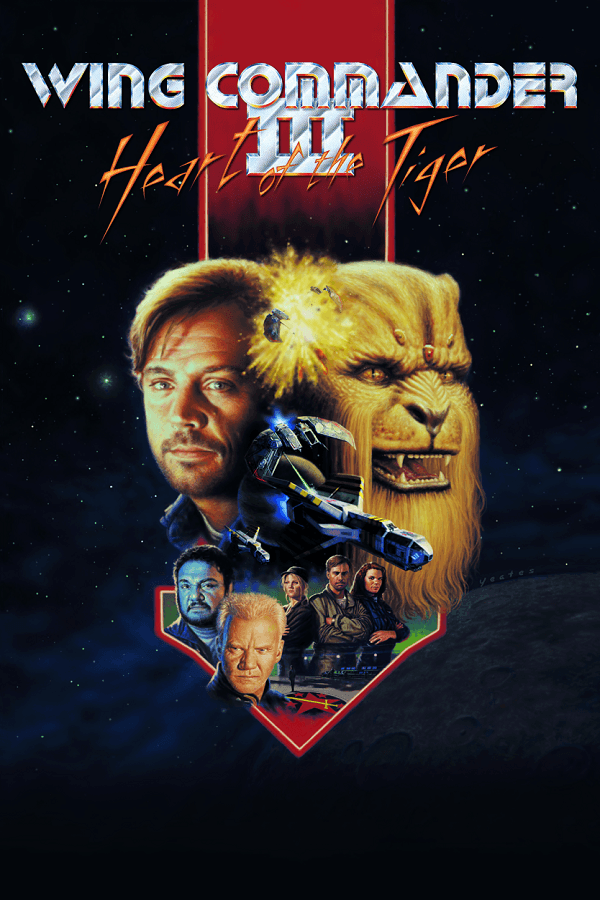

Building Wing Commander III: Heart of the Tiger on real-time texture-mapped 3D polygons instead of flat 2D bitmaps changed PC dogfighting forever, but it also meant your 486 processor was about to choke on four million dollars of Chris Roberts' ambition.
The Confederation is losing, the flagship Concordia lies ruined, and Colonel Christopher "Maverick" Blair gets assigned to the aging carrier TCS Victory for a desperate final push against the Kilrathi Empire. Between sorties in space, you walk through the carrier's bays, talking with crew members like Hobbes, Cobra, and Rachel, picking your wingman, choosing ship armaments, and sitting through pre-flight briefings. What set the game apart from previous entries was the total shift to live-action green-screen video starring Mark Hamill, Malcolm McDowell, John Rhys-Davies, and Tom Wilson. Instead of hand-drawn mouth movements, you watched actual Hollywood actors react to your choices in branching conversations.
That high-budget production cost somewhere between $4 million and $5 million, which made this 1994 release the most expensive computer game made up to that point. Moving from 2D sprites to Origin's RealSpace engine gave space flight true 3D depth in SVGA, but it required a monster system to render smoothly. If you owned a basic 486 without a fast CD-ROM drive, video clips lagged and space combat turned into a slide show. It was a primary reason thousands of players opened their PC cases that winter to drop serious money on RAM upgrades and VLB graphics accelerators.
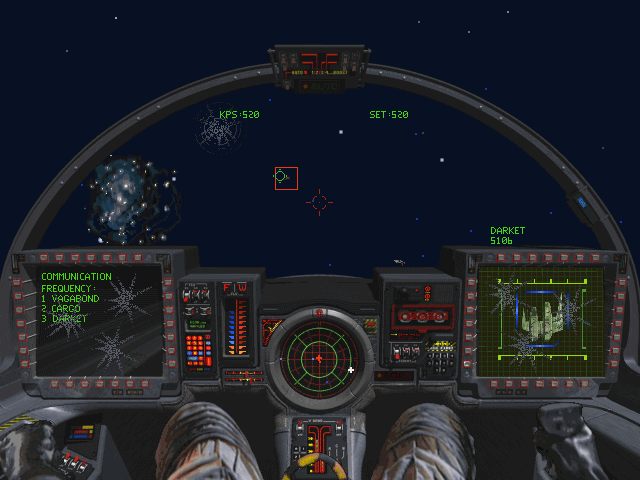
Once you clear the flight deck, space combat relies heavily on balancing target locks, weapon energy, and thrusters against aggressive alien swarms. Flying fighters like the nimble Arrow or heavy bombers like the Longbow requires distinct tactical approaches, especially when managing power routing across your shields, engines, and weapons on the fly. The Inertial Targeting and Tracking System (ITTS) projects a lead sight ahead of your target, showing exactly where to fire to compensate for ship speed and distance. You blast through enemy fighters using a mix of equipment:
The dogfighting is tight, but late-game difficulty spikes will test your patience. Escort missions through the Freya and Alcor systems throw dense waves of alien interceptors at helpless transports, where a single missed turn means watching your objective explode in seconds. Facing off against named Kilrathi aces like Crown Prince Thrakhath nar Kiranka forces you to use every sharp roll and energy trick you have learned just to stay on his tail.
For all its technological polish, the dogfighting mechanics could feel finicky depending on your input setup. Playing this action space flight simulation with a mouse often resulted in jerky flight vectors, while standard joysticks frequently suffered calibration drift that locked the target reticle toward the upper-left corner of the screen. Players who could not pass a grueling escort mission often resorted to typing wc3 -mitchell at the command line, enabling instant-kill shortcuts like Ctrl+F10 to vaporize individual targets or Ctrl+Alt+F10 to clear the entire sector.
Sound support was exceptional for its period, taking full advantage of Roland LAPC-1, MT-32, and Sound Blaster Pro hardware to deliver heavy engine rumbles and dynamic musical cues that shifted whenever an enemy locked onto your tail. Programmers also hid subtle easter eggs inside the software itself, including a brownie recipe embedded in the end credits and the secret Latin phrase "Nos fecimus hoc" buried inside the main executable file. Commercial success followed quickly, as ORIGIN Systems, Inc. saw the title sell over 700,000 copies and become Electronic Arts' initial million-dollar seller on MS-DOS.
Looking back at this 1994 release, the core dogfighting and cockpit HUD management still hold up once you get past the mid-nineties video compression artifacts. The real-time software rendering works because the ship designs are clean and recognizable, even if the cinematic clips look grainy on modern monitors. The real problem is those brutal late-game escort sequences, where a single AI wingman blunder can waste twenty minutes of careful flying. Still, the weight of the ships and the speed of the dogfights make it a space combat campaign worth playing.
You can launch this original release directly in your web browser with simple controls and zero configuration hassles. Skip the nightmare of configuring old DOS extended memory or fighting with joystick drivers, and dive straight into the cockpit of an Excalibur fighter to finish the war against the Kilrathi Empire right now.
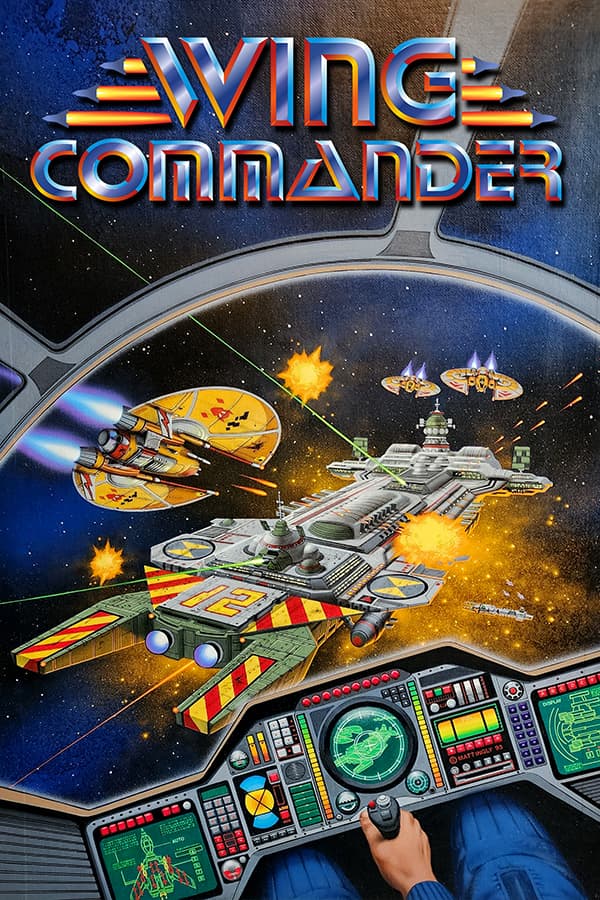
Building Wing Commander III: Heart of the Tiger on real-time texture-mapped 3D polygons instead of flat 2D bitmaps changed PC dogfighting forever, but it also meant your 486 processor was about to choke on four million dollars of Chris Roberts' ambition.
The Confederation is losing, the flagship Concordia lies ruined, and Colonel Christopher "Maverick" Blair gets assigned to the aging carrier TCS Victory for a desperate final push against the Kilrathi Empire. Between sorties in space, you walk through the carrier's bays, talking with crew members like Hobbes, Cobra, and Rachel, picking your wingman, choosing ship armaments, and sitting through pre-flight briefings. What set the game apart from previous entries was the total shift to live-action green-screen video starring Mark Hamill, Malcolm McDowell, John Rhys-Davies, and Tom Wilson. Instead of hand-drawn mouth movements, you watched actual Hollywood actors react to your choices in branching conversations.
That high-budget production cost somewhere between $4 million and $5 million, which made this 1994 release the most expensive computer game made up to that point. Moving from 2D sprites to Origin's RealSpace engine gave space flight true 3D depth in SVGA, but it required a monster system to render smoothly. If you owned a basic 486 without a fast CD-ROM drive, video clips lagged and space combat turned into a slide show. It was a primary reason thousands of players opened their PC cases that winter to drop serious money on RAM upgrades and VLB graphics accelerators.
Once you clear the flight deck, space combat relies heavily on balancing target locks, weapon energy, and thrusters against aggressive alien swarms. Flying fighters like the nimble Arrow or heavy bombers like the Longbow requires distinct tactical approaches, especially when managing power routing across your shields, engines, and weapons on the fly. The Inertial Targeting and Tracking System (ITTS) projects a lead sight ahead of your target, showing exactly where to fire to compensate for ship speed and distance. You blast through enemy fighters using a mix of equipment:
The dogfighting is tight, but late-game difficulty spikes will test your patience. Escort missions through the Freya and Alcor systems throw dense waves of alien interceptors at helpless transports, where a single missed turn means watching your objective explode in seconds. Facing off against named Kilrathi aces like Crown Prince Thrakhath nar Kiranka forces you to use every sharp roll and energy trick you have learned just to stay on his tail.
For all its technological polish, the dogfighting mechanics could feel finicky depending on your input setup. Playing this action space flight simulation with a mouse often resulted in jerky flight vectors, while standard joysticks frequently suffered calibration drift that locked the target reticle toward the upper-left corner of the screen. Players who could not pass a grueling escort mission often resorted to typing wc3 -mitchell at the command line, enabling instant-kill shortcuts like Ctrl+F10 to vaporize individual targets or Ctrl+Alt+F10 to clear the entire sector.
Sound support was exceptional for its period, taking full advantage of Roland LAPC-1, MT-32, and Sound Blaster Pro hardware to deliver heavy engine rumbles and dynamic musical cues that shifted whenever an enemy locked onto your tail. Programmers also hid subtle easter eggs inside the software itself, including a brownie recipe embedded in the end credits and the secret Latin phrase "Nos fecimus hoc" buried inside the main executable file. Commercial success followed quickly, as ORIGIN Systems, Inc. saw the title sell over 700,000 copies and become Electronic Arts' initial million-dollar seller on MS-DOS.
Looking back at this 1994 release, the core dogfighting and cockpit HUD management still hold up once you get past the mid-nineties video compression artifacts. The real-time software rendering works because the ship designs are clean and recognizable, even if the cinematic clips look grainy on modern monitors. The real problem is those brutal late-game escort sequences, where a single AI wingman blunder can waste twenty minutes of careful flying. Still, the weight of the ships and the speed of the dogfights make it a space combat campaign worth playing.
You can launch this original release directly in your web browser with simple controls and zero configuration hassles. Skip the nightmare of configuring old DOS extended memory or fighting with joystick drivers, and dive straight into the cockpit of an Excalibur fighter to finish the war against the Kilrathi Empire right now.
aka Wing Commander 3: Heart of the Tiger · Wing Commander III: Heart of the Tiger for Macintosh
How Wing Commander III: Heart of the Tiger is played — the keys the game listens to, grouped by what they do.
Highlighted keys are mapped — hover or tap one to see what it does.
The on-screen keyboard and gamepad mapping the browser player uses on a phone, a tablet or a controller, as opposed to the real keys above. $PRO members make their own in the player and share them here; anyone can pick one to play with.
Cheat codes, console commands and memory pokes for Wing Commander III: Heart of the Tiger — each one verified and attributed.
Sign in to submitHow Wing Commander III: Heart of the Tiger is played — the keys the game listens to, grouped by what they do.
Highlighted keys are mapped — hover or tap one to see what it does.
The on-screen keyboard and gamepad mapping the browser player uses on a phone, a tablet or a controller, as opposed to the real keys above. $PRO members make their own in the player and share them here; anyone can pick one to play with.
Cheat codes, console commands and memory pokes for Wing Commander III: Heart of the Tiger — each one verified and attributed.
Sign in to submit
Wing Commander1990
Wing Commander1990