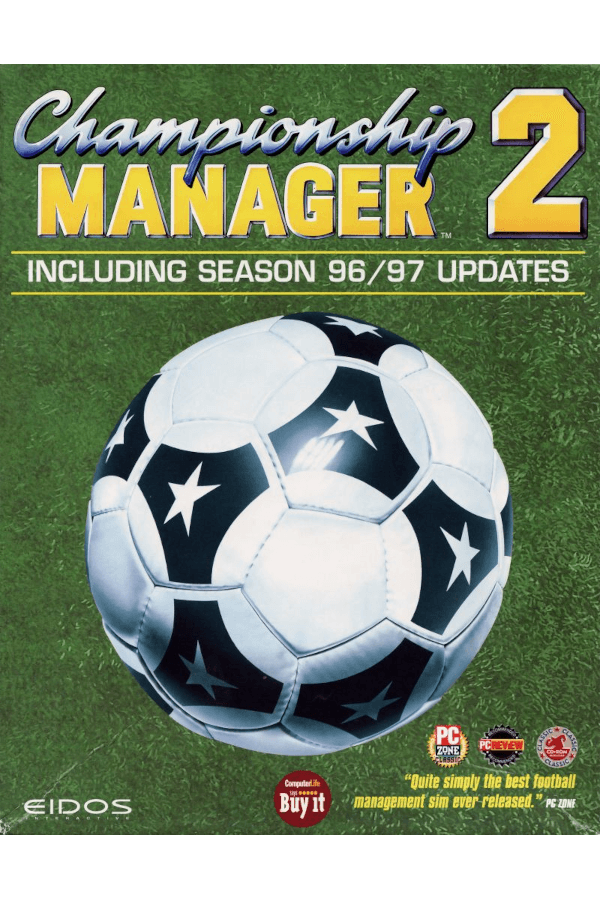
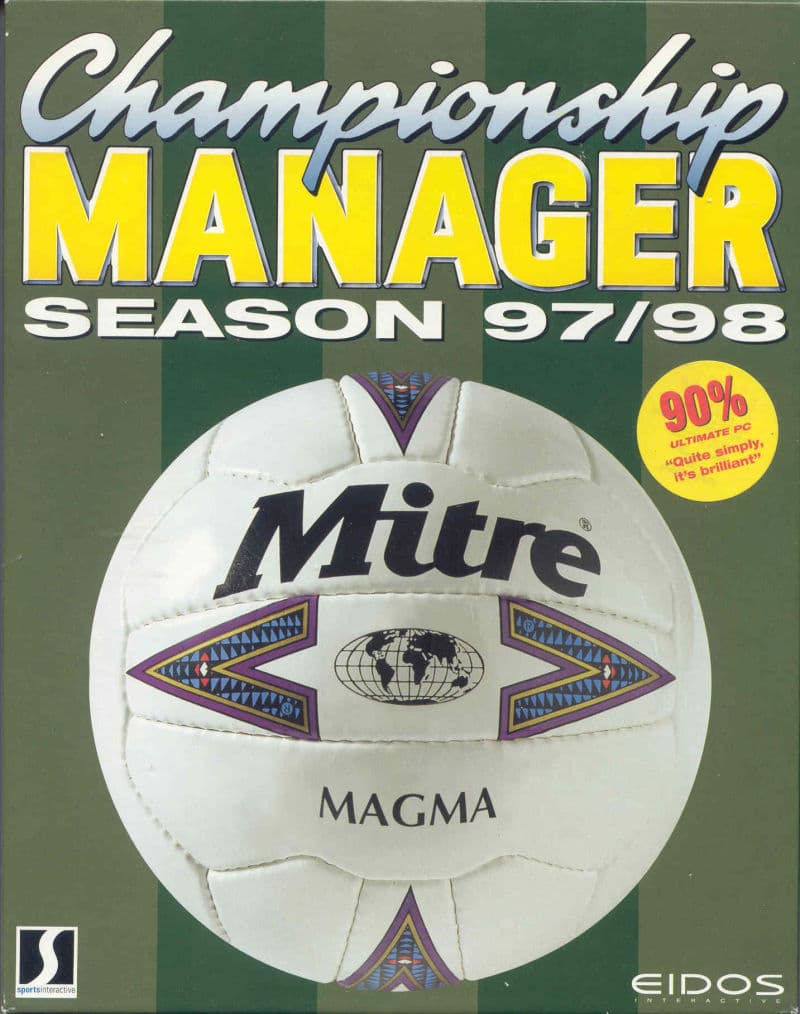
If you loaded up Championship Manager 2: The European Leagues in 1996, you were stepping directly into a world of endless spreadsheet menus, raw numbers, and text commentary that could leave your knuckles white.
Before 3D engines and animated player models took over sports simulation, the entire emotion of a match was conveyed through text scrolling down an SVGA screen. You sat in front of your monitor, watching bold lines of commentary flash across the screen while Clive Tyldesley provided occasional audio commentary over your sound card. When your star striker broke clear in the 89th minute, there was no graphic representation, only a line of text that paused just long enough to make your heart jump before telling you whether the shot hit the back of the net or sailed into the stands.
Created by Paul Collyer and Oliver Collyer at Sports Interactive, this release functioned as a standalone database update to the 1995 engine. It allowed players to take charge of clubs across top European divisions, including the leagues of France, Italy, Spain, Germany, Holland, and Belgium. Handling squad selection, monitoring team morale, dealing with contract disputes, and navigating suspensions felt surprisingly heavy, because the game treated every financial and physical detail with uncompromising seriousness.
Setting up your squad on game day relied on an intuitive design choice that set this release apart from earlier text managers. The SVGA interface featured a tactical screen where you could physically drag and drop your players into position, adjusting pitch locations without wading through endless sub-menus. Moving a midfielder two inches to the left to clog up an opponent's passing lane was simple and direct, contrasting sharply with the dry lists of text that governed the rest of the game.
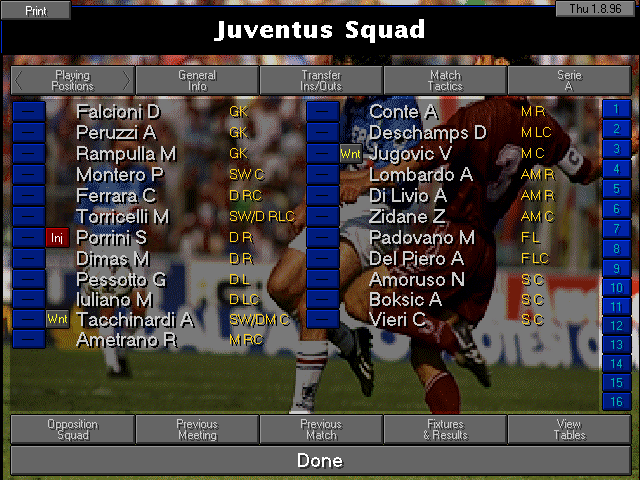
Despite the streamlined pitch board, the simulation underneath remained strict about statistical outcomes. Certain real-world players possessed numbers that became famous among players. In Spain, Sandro (Carlos Sierra Fumero) of Real Madrid B was notorious for developing into an unstoppable force, while Valencia defender Francisco Camarasa routinely delivered average match ratings around 9.35 over an entire campaign. Finding these statistical powerhouses in the massive 4,000-player database was half the fun of setting up a new save.
The transfers and player ratings weren't completely without strange errors, though. The database suffered from notable quirks, including duplicate player entries across squad files. The most famous database glitch was the double Ronaldo listing at PSV, where two separate versions of the Brazilian prodigy existed in the squad, complete with conflicting birth dates.
For all its detail, this 1996 sports management title had interface and structure choices that caused immense frustration. Managing across Europe sounded expansive, but the structural reality meant installing each European league into its own separate hard drive folder. You could only load one national division per installation, meaning you could never run a unified European super-league in a single active save file.
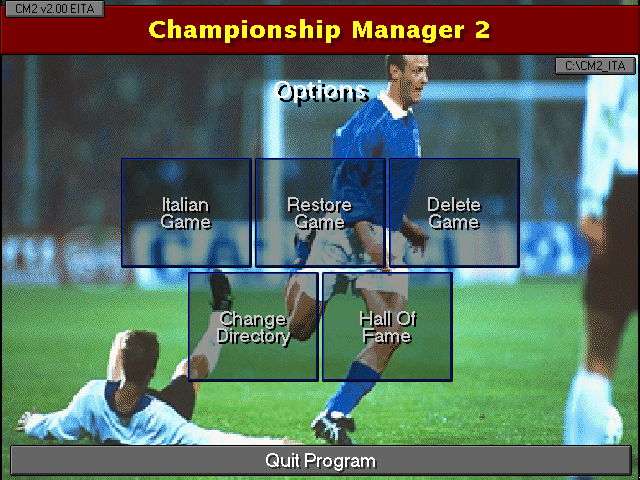
Switching your managerial focus from Serie A to the German Bundesliga meant closing down your run, opening a different directory, and starting a isolated campaign from scratch. The sheer repetition of maintaining separate folder trees was a massive annoyance for anyone hoping to jump fluidly between countries. Furthermore, running this Eidos Interactive release on later hardware often caused the game clock to spin out of control unless processor emulation speeds were manually throttled down.
What works in this early chapter of management history is its absolute focus on raw decision-making. Stripped of glossy graphical cutscenes and media interaction minigames, victory depends purely on your ability to evaluate squad stamina, balance contract budgets, and notice when your midfield is getting overrun. It punishes reckless spending and lazy tactical changes without offering any visual flash to disguise your mistakes.
If you enjoy deep tactical planning and historical database hunting, taking charge of an obscure European club in this classic era remains rewarding. The simple satisfaction of taking a mid-table Belgian squad to European glory through smart transfers and precise formation tweaks is intact.
You can play Championship Manager 2: The European Leagues online, free in your browser right now with nothing to install. Beginners usually make the mistake of setting their line too high without checking defender pace stats, so spend your first ten minutes looking at player attributes before pressing spacebar to start your opening match.
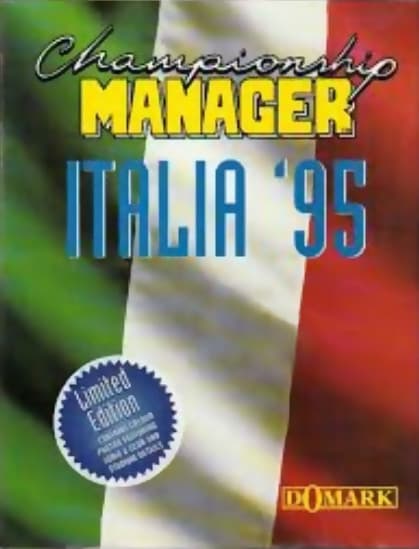
If you loaded up Championship Manager 2: The European Leagues in 1996, you were stepping directly into a world of endless spreadsheet menus, raw numbers, and text commentary that could leave your knuckles white.
Before 3D engines and animated player models took over sports simulation, the entire emotion of a match was conveyed through text scrolling down an SVGA screen. You sat in front of your monitor, watching bold lines of commentary flash across the screen while Clive Tyldesley provided occasional audio commentary over your sound card. When your star striker broke clear in the 89th minute, there was no graphic representation, only a line of text that paused just long enough to make your heart jump before telling you whether the shot hit the back of the net or sailed into the stands.
Created by Paul Collyer and Oliver Collyer at Sports Interactive, this release functioned as a standalone database update to the 1995 engine. It allowed players to take charge of clubs across top European divisions, including the leagues of France, Italy, Spain, Germany, Holland, and Belgium. Handling squad selection, monitoring team morale, dealing with contract disputes, and navigating suspensions felt surprisingly heavy, because the game treated every financial and physical detail with uncompromising seriousness.
Setting up your squad on game day relied on an intuitive design choice that set this release apart from earlier text managers. The SVGA interface featured a tactical screen where you could physically drag and drop your players into position, adjusting pitch locations without wading through endless sub-menus. Moving a midfielder two inches to the left to clog up an opponent's passing lane was simple and direct, contrasting sharply with the dry lists of text that governed the rest of the game.

Despite the streamlined pitch board, the simulation underneath remained strict about statistical outcomes. Certain real-world players possessed numbers that became famous among players. In Spain, Sandro (Carlos Sierra Fumero) of Real Madrid B was notorious for developing into an unstoppable force, while Valencia defender Francisco Camarasa routinely delivered average match ratings around 9.35 over an entire campaign. Finding these statistical powerhouses in the massive 4,000-player database was half the fun of setting up a new save.
The transfers and player ratings weren't completely without strange errors, though. The database suffered from notable quirks, including duplicate player entries across squad files. The most famous database glitch was the double Ronaldo listing at PSV, where two separate versions of the Brazilian prodigy existed in the squad, complete with conflicting birth dates.
For all its detail, this 1996 sports management title had interface and structure choices that caused immense frustration. Managing across Europe sounded expansive, but the structural reality meant installing each European league into its own separate hard drive folder. You could only load one national division per installation, meaning you could never run a unified European super-league in a single active save file.

Switching your managerial focus from Serie A to the German Bundesliga meant closing down your run, opening a different directory, and starting a isolated campaign from scratch. The sheer repetition of maintaining separate folder trees was a massive annoyance for anyone hoping to jump fluidly between countries. Furthermore, running this Eidos Interactive release on later hardware often caused the game clock to spin out of control unless processor emulation speeds were manually throttled down.
What works in this early chapter of management history is its absolute focus on raw decision-making. Stripped of glossy graphical cutscenes and media interaction minigames, victory depends purely on your ability to evaluate squad stamina, balance contract budgets, and notice when your midfield is getting overrun. It punishes reckless spending and lazy tactical changes without offering any visual flash to disguise your mistakes.
If you enjoy deep tactical planning and historical database hunting, taking charge of an obscure European club in this classic era remains rewarding. The simple satisfaction of taking a mid-table Belgian squad to European glory through smart transfers and precise formation tweaks is intact.
You can play Championship Manager 2: The European Leagues online, free in your browser right now with nothing to install. Beginners usually make the mistake of setting their line too high without checking defender pace stats, so spend your first ten minutes looking at player attributes before pressing spacebar to start your opening match.
How Championship Manager 2: The European Leagues is played — the keys the game listens to, grouped by what they do.
Highlighted keys are mapped — hover or tap one to see what it does.
Operates primarily via mouse and text entry; match commentary plays out in real-time.
The on-screen keyboard and gamepad mapping the browser player uses on a phone, a tablet or a controller, as opposed to the real keys above. $PRO members make their own in the player and share them here; anyone can pick one to play with.
Cheat codes, console commands and memory pokes for Championship Manager 2: The European Leagues — each one verified and attributed.
Sign in to submitHow Championship Manager 2: The European Leagues is played — the keys the game listens to, grouped by what they do.
Highlighted keys are mapped — hover or tap one to see what it does.
Operates primarily via mouse and text entry; match commentary plays out in real-time.
The on-screen keyboard and gamepad mapping the browser player uses on a phone, a tablet or a controller, as opposed to the real keys above. $PRO members make their own in the player and share them here; anyone can pick one to play with.
Cheat codes, console commands and memory pokes for Championship Manager 2: The European Leagues — each one verified and attributed.
Sign in to submit