Playing Hugo 4 feels like watching an interactive cartoon where every mistake instantly drops your troll into a ravine or leaves him crushed under a giant snowball.
What Hugo 4 forces you to dodge on the slope
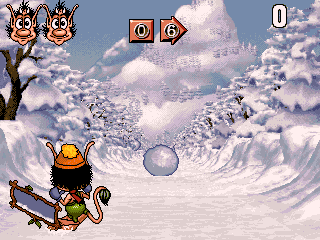
The moment you launch the snowboarding stage in Hugo 4, the basic rhythm of ITE Media's famous troll games hits you immediately. You push Hugo down a snow-covered hill while dodging giant rolling snowballs, steering around gaping chasms, and trying to scoop up stray gold bags along the way. Controls are intentionally simple, keeping the roots of the original interactive TV format where home viewers called in and played live using DTMF tones on a touch-tone telephone handset.
That broadcast heritage leaves this 1996 MS-DOS game feeling distinctly different from standard PC platformers of the mid-nineties. You get four main obstacle courses in total: snowboarding down the mountain, riding a Nimbus motorcycle around goats and potholes, navigating a leaky underground cavern, and steering a punctured hot air balloon down a narrow canyon.
The ballooning stage and Hexana's lair
While the motorcycle and snowboard minigames offer straightforward arcade steering, the difficulty curve spikes violently once you board the hot air balloon. Trying to guide a leaky, sinking airship down a treacherous ravine requires precise input, and hitting a single cliff wall usually means restarting the entire run. It is by far the most frustrating segment of the entire set, stopping plenty of players from ever seeing the side-scrolling phase that follows it.
If you survive the four hazard courses, you finally gain entry to the castle lair of the witch Hexana, who also goes by the names Scylla and Afskylia across different European releases. Your reward for reaching the end is the infamous "rope scene" (or Seilszene), where you are forced to pick one of three ropes to lower a cage and rescue Hugo's family: his wife Hugoline and their three kids, Rit, Rat, and Rut. Pick the wrong rope and Hexana flings Hugo straight out of the castle, sending you right back to the start.
Minigame mechanics and secret level passwords
The variety between stages keeps the package moving quickly, even if the individual games are brief:
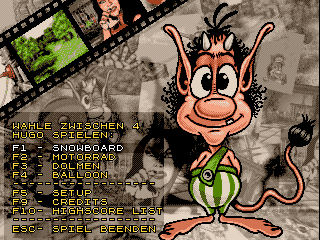
- Snowboard: High-speed downhill steering focused on jumping gaps and gathering gold.
- Motorcycle: Road navigation where dodging stray goats and collecting gas cans keeps your engine running.
- Dolmen Cave: A haunted maze where you must locate an elevator exit before water floods the floor.
- Balloon: High-precision Descent-style air control down a jagged mountain gap with a puncturing leak.
If the balloon stage breaks your patience, the original developers built in numerical stage passwords so you can jump straight to later levels. Entering codes like 4124463113 for level two or 8416877318 for level twelve skips the worst of the trial-and-error design. You can even slowly regain missing health during play by holding the Shift key and tapping the plus [+] key on your keyboard.
How this release holds up today
As a piece of Danish software history, the game is an intriguing capsule of nineties multi-platform media strategy. In Germany, players picked up the retail box under the title Hugo ist nicht zu bremsen!, while Swedish gamers knew it as Hugo: Äventyret går vidare... before it was eventually bundled into compilations like Hugo Platin and Hugo Classic #2. It offers quick, immediate action gameplay that prioritizes fast reaction times over complex control schemes.
The core package suffers from sharp spikes in trial-and-error difficulty, but its crisp character animations and bright cartoon style still look distinct. Anyone who appreciates classic DOS arcade titles will find plenty of charm in its simple mechanics, provided they bring a little patience for that canyon balloon trip.
Play Hugo 4 free in your browser right now
You can experience the complete ITE Media ApS adventure right here without hunting down original CD-ROM media or struggling with manual installation workarounds. If you want to play Hugo 4 online, the DOS version of Hugo 4 runs directly in your web browser with zero setup required, letting you take on Hexana's obstacle course in seconds.