Hugo Labyrinth
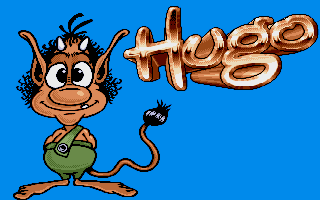
If you played Hugo Labyrinth on a beige PC, you probably remember a chatty troll knocking directly on your monitor screen asking for help.
A phone-in TV game squeezed onto a PC floppy disk
The entire design of Hugo Labyrinth rests on a single historical fact: it was originally built for live callers using touch-tone landline phones. Danish studio ITE Media ApS created the character for the television show Eleva2ren in 1990. Kids called the studio and pounded their home telephone keypads to steer a 220-year-old troll live on air.
When the concept landed on MS-DOS in 1992, the developers kept the tight inputs and direct fourth-wall breaks intact. Danish actor Michael Brockdorf provided digitized voice samples that was startling to hear through a standard PC speaker setup. Hugo would tap on the glass from inside your display if you hesitated too long, demanding action in crisp digitized speech.
That broadcast heritage explains why the game feels unlike almost any other platformer or maze crawler from the same year. It was never designed for deep exploration or endless grinding. It was engineered to give a caller thirty seconds of panic, high tension, and instant entertainment before the television host moved on to a commercial break.
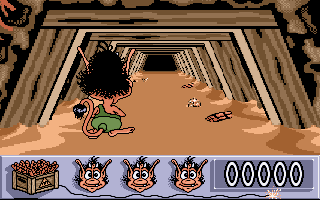
Steering Hugo through the minefield of the first stage
The main portion of the game traps Hugo inside an underground gold mine where rapid decisions are mandatory. Your primary job is navigating dark track junctions to collect scattered gold nuggets while dodging constant hazards. Coal wagons speed along the tracks without warning, and stray sticks of dynamite lay primed across your path.
Time works against you in a very visual way. A burning fuse constantly ticks down across the display, leading straight toward a massive box of TNT. If the fuse burns out before you find the exit, the entire mine explodes instantly. That timer keeps the pressure on your movement, leaving almost no room for wrong turns.
The controls feel stiff until you understand their original purpose. Because the input scheme was built around telephone buttons, Hugo turns along set grid lines rather than moving freely. You have to anticipate turns early, planning your trajectory across the tracks before the cart or hazard reaches your square.
Failure comes with immediate slapstick comedy. When Hugo collides with dynamite or gets clipped by a coal wagon, you get a quick death animation before restarting. These cartoonish setbacks were the highlight of the original broadcast, and they lose none of their silly charm on standard PC hardware.
The flaw in Hugo Labyrinth is how brief the ride really is
If you compare this release with full-length action games from 1992, the single biggest issue becomes obvious immediately. There are no save slots, no sprawling map networks, and no long campaign paths to master over weeks of play. Modern speedrunners and retro players often point out that the package feels more like a tech demo than a full release.
The entire experience is divided into three quick phases that can be completed in minutes if you know what you are doing:
- The underground gold mine maze filled with tracks, nuggets, moving carts, and a lit TNT fuse.
- The precarious hanging rope bridge over a chasm with massive missing planks you must leap over.
- The final cave room containing three locked doors, where a blind pick determines if you reach the treasure.
That minimalist structure means replay value depends entirely on chasing high scores and testing your reflexes. Once you learn the pattern of the mine tracks and master the jump timing on the bridge, the mystery vanishes completely. You are left with a quick, punchy arc that demands total focus for five minutes and then ends abruptly.
Crossing the rope bridge and picking the right door
After surviving the mine tracks, Hugo emerges onto an unstable hanging rope bridge stretched across a deep underground pit. Huge gaps pepper the wooden planks, forcing you to time every single forward step with care. Missing a jump sends the troll plummeting downward, instantly ending what might have been a perfect run.
Surviving the bridge leads straight into the final chamber, where logic steps aside in favor of pure guesswork. Hugo stands before three identical wooden doors carved into the stone cliff face. Only one of those doors leads directly to the hidden room packed with gold, while the others trigger sudden traps that strip away your hard-earned winnings.
This final gambit feels deliberately unfair by modern game design standards, but it fitted the televised game show atmosphere perfectly. Home callers on live TV either won big or lost everything on a final button press, creating genuine suspense for everyone watching at home. Publisher NBG EDV Handels- und Verlags GmbH distributed the MS-DOS release to home computer owners, preserving that exact television tension.
The game presents a clear divide between presentation and depth. The digitized voice work, expressive animations, and TV history make it a unique piece of software, even if the core mechanics lack long-term complexity. It sits in a strange niche among games from 1992, functioning half as a historical artifact and half as an arcade reflex test.
How to play Hugo Labyrinth online today
You do not need to hunt down rare floppy disks or configure old system files to check out this weird piece of Danish computer history. You can play Hugo Labyrinth free in your browser right here on this site, with zero setup required. It loads immediately, bringing the complete original DOS release straight to your current screen with full sound support.
First-time players often assume they can maneuver Hugo like a standard platforming character using quick directional taps. Remember that movements execute along a fixed grid system rooted in old telephone keypads, so input your turns early before the tracks split. Jump into the mine, dodge the coal carts, pick a door at the end, and see if you can claim the troll gold on your first try.