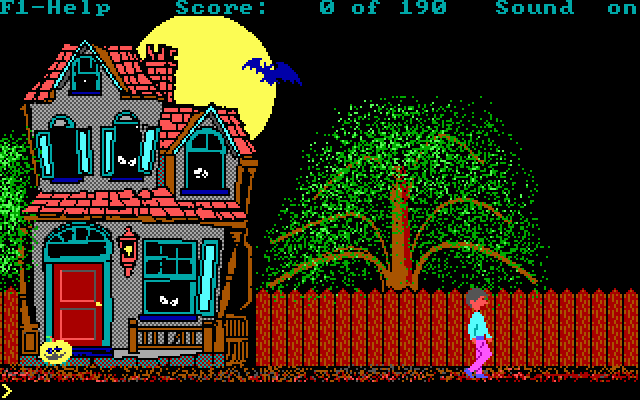
In Hugo's House of Horrors, you walk straight up to a haunted mansion, smash a pumpkin on the porch to find a key, and hope the text parser understands what you want to do with the dog inside.
If you grew up grabbing shareware disks off store racks or fetching files from local BBS boards, you probably remember the initial shock of opening Hugo's House of Horrors. Built by British developer David P. Gray under his studio Gray Design Associates, it looked like a Sierra adventure stripped down to its bare essentials. You play as Hugo, trying to rescue your girlfriend Penelope after she disappears during a babysitting job inside a creepy estate, and the game wastes no time placing you on the front yard facing a locked door.
The parser setup feels familiar if you ever played Leisure Suit Larry in the Land of the Lounge Lizards, but the engine is Gray's own custom code, with character sprites that took inspiration from Captain Comic. Movement uses the arrow keys, and every action requires typing commands into the text box. The real challenge comes from figuring out the exact verb the game wants. Break open the pumpkin to find the key, type the command to unlock the door, and suddenly you are inside, staring at a vicious watchdog that will chew you up if you move to the wrong tile.
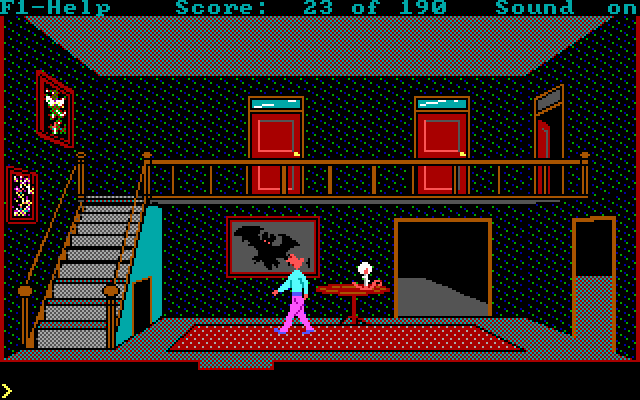
This is not a long quest. Once you know every answer, you can run through the entire story in less than ten minutes. The friction comes entirely from real-time hazard positioning and strict text parsing. Throwing a bone to distract the dog is simple enough, but later rooms leave almost no room for error. When you step into the basement caverns, a swarm of bats rushes you, forcing you to type the command to blow a whistle before the sprites collide with your character.
The narrow pathing makes certain screens infuriating. Getting past the deadly mummy requires luring it behind a rock, which sounds simple until you realize a single pixel of bad movement triggers an instant death. Players who spent hours wrestling with these puzzles back in 1990 were not just fighting the logic of the items, but the precise placement of Hugo on the screen.

Despite its crude 16-color EGA graphics and screeching PC-speaker audio, the game became a massive shareware success story. Because the first chapter could be freely copied and passed around, it spread everywhere. If you got completely stuck on the end-game riddle session with the old man, Gray Design Associates was ready to help. You could order registered copies by mail, and Gray even sold an official hint book along with a dedicated "solver" utility that automatically played through the puzzle steps on screen like a movie.
The text parser also hid a few fun responses for people who typed bizarre commands. Trying to inspect things that were not part of the puzzle logic often returned sarcastic commentary, including special text if you tried to look under the front door mat. That playful tone helped offset the stiff visuals and loud, primitive sound effects that chirped whenever Hugo moved or interacted with an object.
Compared to commercial giants of 1990, this release had plenty of rough edges, but it took only an afternoon to beat and stuck in your head anyway. It spawned two direct parser sequels, Hugo II, Whodunit? and Hugo III, Jungle of Doom!, before the series took a hard turn into first-person action with Nitemare 3D. When Gray updated the package for Windows in 1995, it gained point-and-click controls and digital sound, but the raw low-res original is still the version people recall most vividly.
If you enjoy classic adventure games built by solo creators, this short chapter is worth an evening. It lacks the polish of high-budget Sierra hits, but working through its rooms provides a clear picture of how shareware authors built entire worlds out of basic engine code and clever ideas.
You can play Hugo's House of Horrors free in your browser right now on this page. Running the Gray Design Associates classic in a web window lets you experience the sudden panic of the bat cavern and the exact timing of the text parser without setting up an emulator. Launch the game, type your commands carefully, and see if you can rescue Penelope on your very first run.

In Hugo's House of Horrors, you walk straight up to a haunted mansion, smash a pumpkin on the porch to find a key, and hope the text parser understands what you want to do with the dog inside.
If you grew up grabbing shareware disks off store racks or fetching files from local BBS boards, you probably remember the initial shock of opening Hugo's House of Horrors. Built by British developer David P. Gray under his studio Gray Design Associates, it looked like a Sierra adventure stripped down to its bare essentials. You play as Hugo, trying to rescue your girlfriend Penelope after she disappears during a babysitting job inside a creepy estate, and the game wastes no time placing you on the front yard facing a locked door.
The parser setup feels familiar if you ever played Leisure Suit Larry in the Land of the Lounge Lizards, but the engine is Gray's own custom code, with character sprites that took inspiration from Captain Comic. Movement uses the arrow keys, and every action requires typing commands into the text box. The real challenge comes from figuring out the exact verb the game wants. Break open the pumpkin to find the key, type the command to unlock the door, and suddenly you are inside, staring at a vicious watchdog that will chew you up if you move to the wrong tile.

This is not a long quest. Once you know every answer, you can run through the entire story in less than ten minutes. The friction comes entirely from real-time hazard positioning and strict text parsing. Throwing a bone to distract the dog is simple enough, but later rooms leave almost no room for error. When you step into the basement caverns, a swarm of bats rushes you, forcing you to type the command to blow a whistle before the sprites collide with your character.
The narrow pathing makes certain screens infuriating. Getting past the deadly mummy requires luring it behind a rock, which sounds simple until you realize a single pixel of bad movement triggers an instant death. Players who spent hours wrestling with these puzzles back in 1990 were not just fighting the logic of the items, but the precise placement of Hugo on the screen.

Despite its crude 16-color EGA graphics and screeching PC-speaker audio, the game became a massive shareware success story. Because the first chapter could be freely copied and passed around, it spread everywhere. If you got completely stuck on the end-game riddle session with the old man, Gray Design Associates was ready to help. You could order registered copies by mail, and Gray even sold an official hint book along with a dedicated "solver" utility that automatically played through the puzzle steps on screen like a movie.
The text parser also hid a few fun responses for people who typed bizarre commands. Trying to inspect things that were not part of the puzzle logic often returned sarcastic commentary, including special text if you tried to look under the front door mat. That playful tone helped offset the stiff visuals and loud, primitive sound effects that chirped whenever Hugo moved or interacted with an object.
Compared to commercial giants of 1990, this release had plenty of rough edges, but it took only an afternoon to beat and stuck in your head anyway. It spawned two direct parser sequels, Hugo II, Whodunit? and Hugo III, Jungle of Doom!, before the series took a hard turn into first-person action with Nitemare 3D. When Gray updated the package for Windows in 1995, it gained point-and-click controls and digital sound, but the raw low-res original is still the version people recall most vividly.
If you enjoy classic adventure games built by solo creators, this short chapter is worth an evening. It lacks the polish of high-budget Sierra hits, but working through its rooms provides a clear picture of how shareware authors built entire worlds out of basic engine code and clever ideas.
You can play Hugo's House of Horrors free in your browser right now on this page. Running the Gray Design Associates classic in a web window lets you experience the sudden panic of the bat cavern and the exact timing of the text parser without setting up an emulator. Launch the game, type your commands carefully, and see if you can rescue Penelope on your very first run.
How Hugo's House of Horrors is played — the keys the game listens to, grouped by what they do.
Highlighted keys are mapped — hover or tap one to see what it does.
The on-screen keyboard and gamepad mapping the browser player uses on a phone, a tablet or a controller, as opposed to the real keys above. $PRO members make their own in the player and share them here; anyone can pick one to play with.
Cheat codes, console commands and memory pokes for Hugo's House of Horrors — each one verified and attributed.
Sign in to submitHow Hugo's House of Horrors is played — the keys the game listens to, grouped by what they do.
Highlighted keys are mapped — hover or tap one to see what it does.
The on-screen keyboard and gamepad mapping the browser player uses on a phone, a tablet or a controller, as opposed to the real keys above. $PRO members make their own in the player and share them here; anyone can pick one to play with.
Cheat codes, console commands and memory pokes for Hugo's House of Horrors — each one verified and attributed.
Sign in to submit
Hugo's House of Horrors1990 · this page